
If you have ever noticed an outlet in your bathroom, kitchen, or garage with two small buttons labeled TEST and RESET, you have already seen a GFCI outlet in action. Most homeowners walk past them every single day without thinking much about them, but those two buttons represent one of the most important safety advancements in residential electrical history.
At Zimmerman Electric, we install and replace GFCI outlets in homes and businesses across Indianapolis, Marion County, Hamilton County, and all of Central Indiana. In this guide, we break down exactly what a GFCI outlet is, how it works, where Indiana building code requires it, how much installation costs in our service area, and when it is time to call a licensed electrician rather than tackle the job yourself.
What Is a GFCI Outlet?
GFCI stands for Ground Fault Circuit Interrupter. You may also see it written as GFI (Ground Fault Interrupter) — both terms refer to the same device. A GFCI outlet is a specialized electrical receptacle designed to detect even the smallest imbalance in electrical current flowing between the hot and neutral wires.
Here is how it works in plain terms: under normal operation, the same amount of current that leaves an outlet through the hot wire returns through the neutral wire. If electricity begins taking an unintended path, such as through water, a wet hand, or a grounded surface, the current balance shifts. A GFCI outlet detects that imbalance in as little as 4 to 5 milliamps and shuts off power in under one-thirtieth of a second. That is fast enough to prevent serious injury and, in many cases, to save a life.
Why GFCI Outlets Matter in Homes
Before GFCI outlets became widespread, roughly 800 people died annually in the United States from home electrical accidents. That number has dropped to around 200 per year, largely because of mandatory GFCI protection in moisture-prone areas. According to the Electrical Safety Foundation International (ESFI), proper GFCI protection could prevent approximately 47 percent of all residential electrocutions that still occur today.
For Central Indiana homeowners, GFCI outlets are not optional in code-required locations. The NEC, which Indiana adopts and enforces, makes GFCI protection mandatory in specific rooms and outdoor areas in all new construction and in any electrical work that involves those areas.
What Does a GFCI Outlet Look Like?
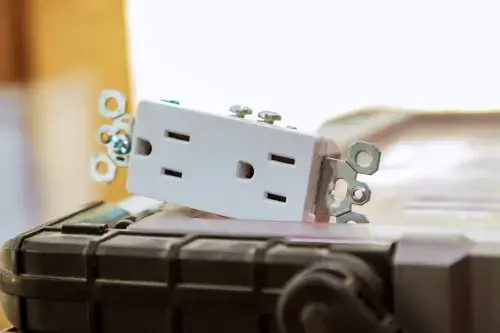
A GFCI receptacle is easy to identify. It looks similar to a standard three-prong outlet, but it has two buttons centered between the plug slots:
- TEST button: Simulates a ground fault to verify the outlet is working.
- RESET button: Restores power after the outlet has tripped or after a successful test.
Some models also include an indicator light that turns red when the device has tripped or needs replacement. GFCI outlets are slightly thicker than standard outlets, which is why older electrical boxes occasionally need replacement when upgrading to GFCI protection.
How Does a GFCI Outlet Work? (The Technical Explanation, Made Simple)
A GFCI outlet contains a small differential current transformer that continuously monitors the current flowing through the hot wire versus the neutral wire. Under normal conditions, those two values are equal. The moment a ground fault occurs, meaning electricity finds a path to ground outside the intended circuit, the two values diverge.
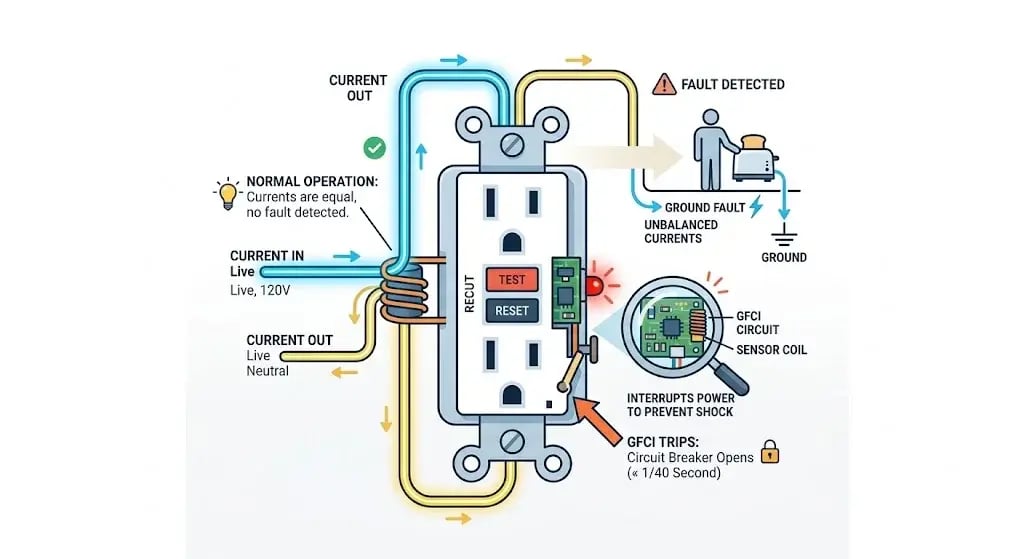
That divergence triggers the GFCI to open its internal relay and cut power. The entire process happens in under 30 milliseconds, which is significantly faster than a standard circuit breaker. A circuit breaker is designed to protect wiring from overcurrent damage. A GFCI is designed to protect people from electrical shock. They serve different purposes, and your home needs both.
|
REAL-WORLD SCENARIO You plug a hair dryer into your bathroom outlet. While it is running, it accidentally falls into a sink full of water. Without GFCI protection, electricity would flow through the water and potentially through you. With a GFCI outlet properly installed, the device detects the fault within milliseconds and cuts power before serious harm can occur. This is why GFCI outlets have been mandatory in bathrooms since 1975. |
GFCI Receptacle vs. GFCI Circuit Breaker: What Is the Difference?
Homeowners often ask whether they need a GFCI outlet at every location or if one device can protect an entire circuit. The answer depends on which type of GFCI protection is installed:
|
Type |
How It Works and Where It Is Best |
|
GFCI Receptacle (Outlet) |
Installed at one outlet location. Can be wired to also protect all outlets downstream on the same circuit. Most common in kitchens, bathrooms, and garages. |
|
GFCI Circuit Breaker |
Installed in the electrical panel and protects every outlet and fixture on an entire circuit. Ideal for areas with multiple outlets like a garage or large outdoor space. |
|
Portable GFCI Device |
A plug-in adapter used on job sites or in temporary applications. Not appropriate for permanent residential use. |
For most Central Indiana homes, a combination of GFCI receptacles in high-use areas and GFCI breakers in the panel for complex circuits is the most cost-effective approach. Our team at Zimmerman Electric assesses your home's existing wiring during every estimate to recommend the right solution for your specific layout.
Where Are GFCI Outlets Required by Code in Indiana?
The National Electrical Code (NEC) governs where GFCI protection is required in residential and commercial construction across Indiana. The 2023 NEC significantly expanded these requirements compared to older code versions. If your Indianapolis home was built or last updated before 2020, there is a strong chance you are missing GFCI protection in at least a few locations.
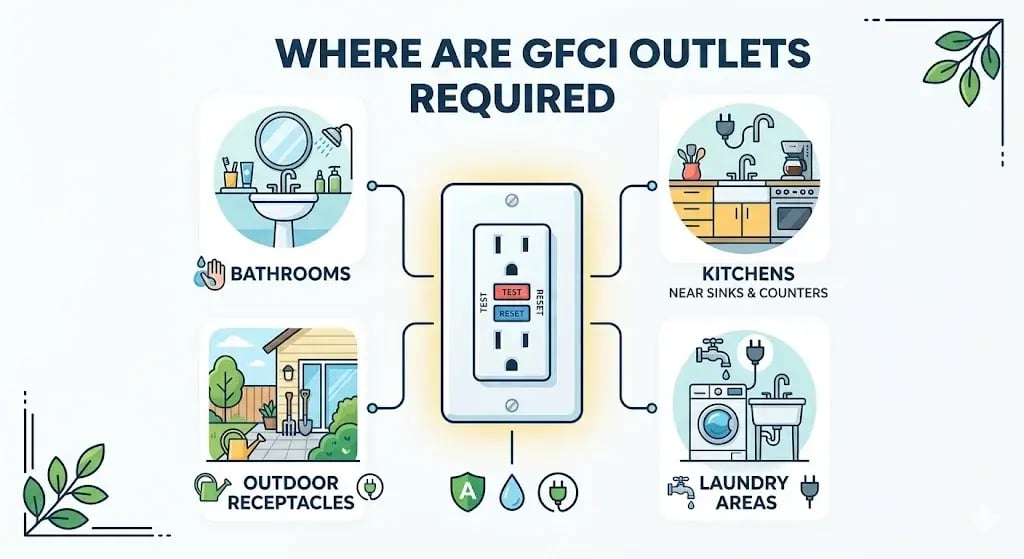
Room-by-Room GFCI Requirements Under 2023 NEC
|
Location |
NEC Requirement |
Notes for Indiana Homeowners |
|
Bathrooms |
All 15A and 20A, 125V outlets |
Required since 1975. Every bathroom outlet must have GFCI protection, regardless of distance from water. |
|
Kitchen Counter |
All receptacles within 6 feet of a sink |
Required since 1987. Covers countertop outlets. Dishwasher and refrigerator circuits have specific rules. |
|
Garages |
All 15A and 20A, 125V outlets |
Required since 1978. Applies to both attached and detached garages. Affects EV charger outlets too. |
|
Unfinished Basements |
All outlets except those serving specific equipment |
Required since 1990. Finished basements with no water sources may use standard outlets in living areas. |
|
Crawl Spaces |
All outlets at or below grade level |
Applies whenever an outlet exists in a crawl space. |
|
Outdoor Areas |
All 15A and 20A, 125V outdoor receptacles |
Includes decks, patios, porches, balconies, and exterior walls. Must also be weatherproof-rated. |
|
Laundry Rooms |
All 15A and 20A outlets |
Added in the 2005 NEC update. Applies to utility sinks and laundry areas. |
|
Pool and Spa Areas |
All receptacles within 20 feet of pool edge |
Governed by NEC 680. Strict rules apply. Professional installation required. |
|
Boat Docks |
All outlets on docks and boathouses |
Applies to any water-adjacent structure with electrical supply. |
|
IMPORTANT NOTE FOR OLDER INDIANAPOLIS HOMES Homes built before 1975 may have no GFCI protection anywhere in the house. Older homes are not automatically required to upgrade just because they are old. However, any time electrical work is performed in a location that now requires GFCI protection under current NEC, the upgrade becomes mandatory at that time. This commonly happens during bathroom remodels, kitchen renovations, panel upgrades, or when adding new circuits. If you are purchasing an older home in Indianapolis or planning a renovation, we recommend scheduling a full electrical safety inspection. Our team can identify all locations requiring GFCI upgrades and give you a clear, itemized estimate. Learn more about our residential electrical services or call us at 317-548-0082. |
Does My Garage Need GFCI Outlets for an EV Charger?
This is one of the most common questions we receive as EV adoption continues to grow in Central Indiana. The short answer is yes, in most cases. All 15A and 20A, 125V garage outlets require GFCI protection under the NEC, and this applies to the standard outlet you might use for a Level 1 charger.
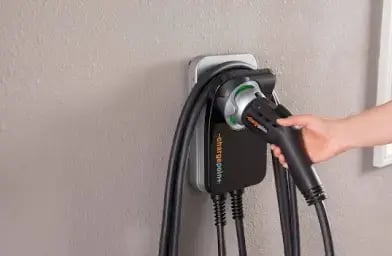
However, most Level 2 EV chargers use a 240V, 50A dedicated circuit, which follows different code requirements. Whether GFCI protection is required for that circuit depends on the outlet type and location within the garage. If you are planning an EV charger installation, our electricians will handle all code compliance including appropriate GFCI protection as part of the installation.
GFCI vs. AFCI Outlets: What Is the Difference?
Homeowners researching electrical safety upgrades frequently come across two similar-sounding devices: GFCI and AFCI. Both are safety technologies required by the NEC, and both serve important roles in protecting your home. However, they protect against completely different electrical hazards.
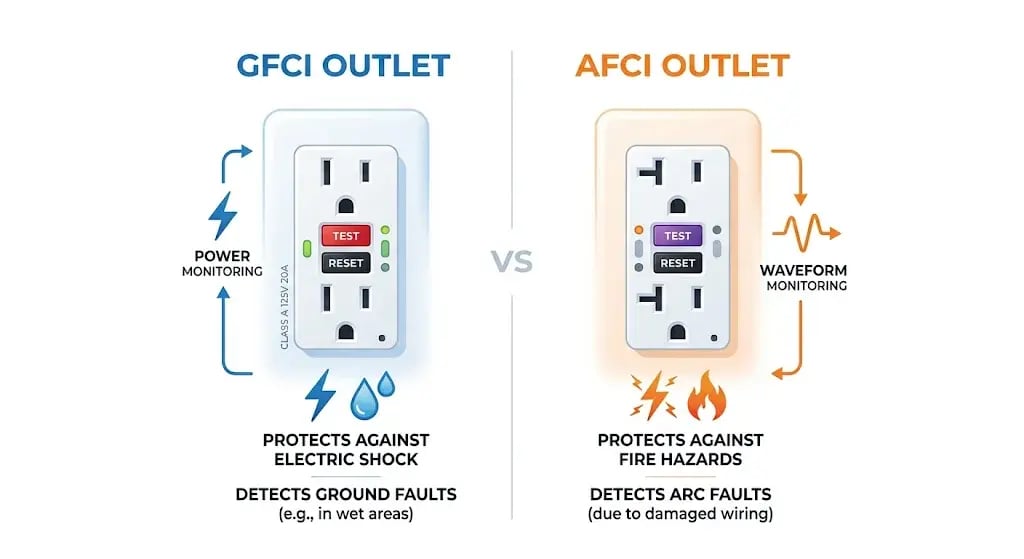
|
Feature |
GFCI vs. AFCI Comparison |
|
Full Name |
GFCI: Ground Fault Circuit Interrupter | AFCI: Arc Fault Circuit Interrupter |
|
Protects Against |
GFCI: Electric shock from ground faults | AFCI: Electrical fires from arc faults |
|
How It Works |
GFCI: Detects current imbalance as small as 4-5mA | AFCI: Detects irregular current waveforms caused by arcing |
|
Where Required |
GFCI: Wet/moisture-prone areas (bathrooms, kitchens, outdoors) | AFCI: Living areas, bedrooms, hallways, family rooms |
|
Appearance |
GFCI: TEST and RESET buttons on outlet face | AFCI: Usually a breaker in the panel, not at the outlet |
Both technologies are required in modern Indiana construction. Many homes built before 2000 lack AFCI protection entirely, which increases fire risk from deteriorating wiring inside walls. Dual-function GFCI/AFCI outlets now exist that provide both types of protection in a single device, and we often recommend these for kitchens and laundry rooms where both hazards are present.
If you are unsure whether your home has adequate AFCI and GFCI protection, a professional electrical inspection is the fastest way to get clarity. Our residential electrical team can assess both and recommend the most cost-effective upgrade path.
GFCI Outlet Installation Cost in Indianapolis (2026 Pricing Guide)
One of the most searched questions we see from Indianapolis homeowners is: how much does GFCI outlet installation cost? The answer depends on a few variables, including the number of outlets being installed, the condition of the existing wiring, and whether your electrical box needs modification.
Typical GFCI Installation Cost Ranges in Central Indiana
|
Scenario |
Estimated Cost |
Notes |
|
Single GFCI outlet replacement |
$300 - $500 |
Replacing one standard outlet with a GFCI in an already-accessible location |
|
Multi-outlet GFCI upgrade (same room) |
$300 - $500 Per Location |
Upgrading multiple outlets in one visit, such as a bathroom or kitchen |
|
GFCI breaker installation (panel) |
$2,500 - $3,000 |
Installed in the electrical panel as part of panel replacement/upgrade work |
|
New GFCI outlet in previously unwired location |
$300 - $500 |
Cost varies by distance from the panel, framing, and accessibility |
Disclaimer: All pricing shown is estimated and intended as a general reference only. Actual project pricing is subject to change based on market conditions, material costs, site conditions, scope of work, and other project-specific factors.
|
A NOTE ON COST TRANSPARENCY FROM ZIMMERMAN ELECTRIC INDY We believe every homeowner deserves upfront pricing before any work begins. Every Zimmerman Electric estimate is provided at no charge, and we quote flat rates wherever possible so there are no billing surprises. We also handle all necessary permits for electrical work in Indianapolis and surrounding counties as part of every job. Call us at (317) 548-5061 or request a free estimate online. |
What Affects the Final Price?
- Age of existing wiring: Homes with aluminum wiring, knob-and-tube wiring, or two-wire (ungrounded) circuits may require additional work before GFCI outlets can be properly installed.
- Outlet box condition: Older metal or shallow boxes may need replacement to accommodate the deeper profile of a GFCI receptacle.
- Number of outlets on the circuit: Installing a single GFCI outlet at the first location in a circuit and wiring it to protect downstream outlets is more cost-effective than replacing every outlet individually.
- Permit requirements: Some electrical work in Indianapolis requires permits through the City of Indianapolis Division of Building and Zoning. We handle this process on your behalf.
- Panel condition: If your panel is outdated or at capacity, a GFCI circuit breaker installation may require panel evaluation. Learn more about electrical panel upgrades and what they include.
How to Test a GFCI Outlet (Step-by-Step)
The Consumer Product Safety Commission recommends testing all GFCI outlets at least once a month. GFCI devices can fail silently, meaning they appear to supply power normally but no longer provide protection. Testing takes less than 30 seconds and can be done by any homeowner.
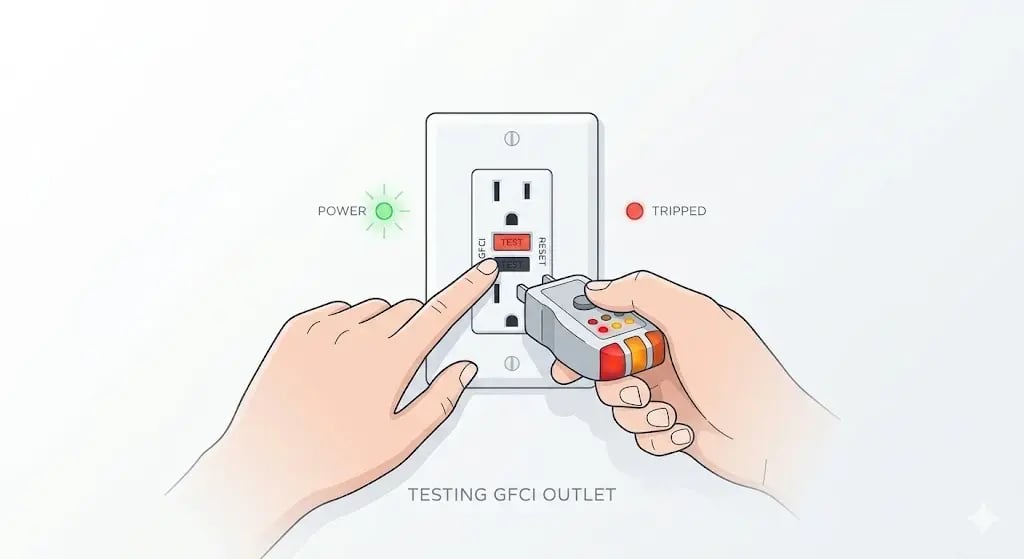
- Locate the GFCI outlet. It will have TEST and RESET buttons on its face, usually in the center between the plug slots.
- Plug in a simple device. Use a night light, phone charger, or lamp so you can see when power cuts.
- Press the TEST button. You should hear a click and the plugged-in device should lose power immediately. If the device stays on, the GFCI is not functioning correctly and should be replaced.
- Press the RESET button. Power should be restored to the outlet and the plugged-in device should turn back on.
- Repeat monthly. Monthly testing confirms the GFCI is both supplying power and capable of tripping when needed.
If your GFCI outlet fails the test, trips repeatedly without an obvious cause, or will not reset, those are signals that it needs professional attention. A non-functional GFCI gives a false sense of security. Call us at (317) 548-5061 and we will diagnose the issue quickly.
Why Won't My GFCI Outlet Reset?
This is one of the most common calls we receive. If your GFCI outlet trips repeatedly or will not reset, the most likely causes are:
- Moisture in the outlet box or wiring: Common in bathrooms and outdoor locations after heavy rain or plumbing leaks.
- An appliance on the circuit with current leakage: Some older motors and fluorescent lights cause nuisance trips. Try unplugging all devices and testing the outlet without any load.
- A wiring fault downstream: A damaged wire or faulty device on the same circuit can cause continuous tripping.
- A worn-out GFCI device: GFCI outlets typically last 15 to 25 years. If yours is older than that, replacement is likely the right call regardless of test results.
Do not ignore a GFCI outlet that keeps tripping. In most cases, the outlet is doing its job and telling you something in your electrical system needs attention. Let a licensed electrician diagnose it properly rather than guessing.
Can One GFCI Outlet Protect Multiple Outlets?
Yes, and this is one of the most cost-effective aspects of GFCI installation. A single GFCI receptacle installed at the first outlet on a circuit can be wired to protect all subsequent outlets on that same circuit. This is called downstream or load-side protection.
For example, if you have five kitchen counter outlets all on the same 20-amp circuit, installing one properly wired GFCI outlet at the beginning of the run provides code-compliant protection for all five locations. The remaining four outlets are standard receptacles but are labeled NO EQUIPMENT GROUND per NEC requirements.
|
IMPORTANT WIRING NOTE Downstream protection only works when the GFCI outlet is correctly wired with the downstream outlets connected to the LOAD terminals, not the LINE terminals. Incorrect wiring is one of the most common DIY mistakes with GFCI outlets, and it results in outlets that appear functional but provide zero downstream protection. This is exactly why we recommend licensed electrician installation for all GFCI work, particularly in kitchens and bathrooms where lives are at stake. |
Can I Install a GFCI Outlet Myself, or Do I Need a Licensed Electrician?
GFCI outlet replacement is one of the few electrical tasks that some confident, safety-conscious homeowners handle themselves, provided specific conditions are met. Here is an honest breakdown of when DIY is reasonable versus when you should call a licensed electrician.
|
Situation |
DIY or Licensed Electrician? |
|
Replacing an existing GFCI outlet that has failed |
DIY-possible for confident homeowners. Power must be off at the breaker. |
|
Replacing a standard outlet with a GFCI in a simple, accessible 3-wire location |
DIY-possible. Confirm it is the last outlet on the circuit. |
|
Wiring a GFCI to protect downstream outlets |
Licensed electrician recommended. Incorrect wiring eliminates downstream protection. |
|
Installing GFCI protection in a 2-wire (ungrounded) circuit |
Licensed electrician required. Requires a label and specific wiring technique. |
|
New GFCI outlet installation requiring new wiring runs |
Licensed electrician required. Permit may be required. |
|
GFCI breaker installation in electrical panel |
Licensed electrician required. Always. |
|
Any GFCI work in homes with aluminum wiring or knob-and-tube |
Licensed electrician required. |
Indiana does not allow unlicensed individuals to perform electrical work that requires a permit on properties they do not own. If you are a homeowner doing your own work, some jurisdictions still require permits and inspections. When in doubt, a consultation with Zimmerman Electric costs nothing and takes the guesswork out of the process.
Does Your Indianapolis Home Need a GFCI Compliance Audit?
If your home was built or last significantly renovated before 2005, there is a meaningful chance it is missing GFCI protection in locations now required by the NEC. The 2005 NEC expansion added laundry rooms to the required list. The 2014 and 2020 cycles added boathouses, kitchen dishwasher circuits, and expanded garage requirements.
Here are the clearest signals that your home is due for a GFCI compliance review:
- You have two-prong outlets in your bathroom, kitchen, or garage.
- Your home was built before 1987 and has never had a significant kitchen electrical update.
- You have standard outlets on any outdoor wall, deck, or patio.
- Your garage outlets do not have TEST and RESET buttons.
- You are buying or selling a home and the inspection flagged GFCI deficiencies.
- You recently installed a hot tub, pool pump, or outdoor kitchen area.
A whole-home GFCI audit from Zimmerman Electric typically takes one to two hours, produces a written list of all non-compliant locations with individual pricing, and gives you a clear picture of your home's electrical safety status. Many homeowners find the audit pays for itself by identifying a handful of high-priority locations rather than replacing every outlet in the house.
We also recommend pairing a GFCI audit with a review of your panel capacity, especially if your home has older wiring or you are planning additions like an EV charger or major appliance upgrades. Learn more about electrical panel upgrades and our whole-house surge protection services, which complement GFCI protection by guarding against voltage spikes from the utility grid and lightning events.
GFCI Outlet Requirements for Outdoor Locations in Indiana
Outdoor GFCI outlets deserve their own section because they are among the most frequently missing and the most hazardous when absent. Every outdoor outlet on your home, including those on the front porch, back patio, deck, balcony, and exterior walls, must be GFCI-protected under NEC 210.8(A)(3).
In addition to GFCI protection, outdoor outlets must also be:
- Weather-resistant (WR) rated: The receptacle itself must carry a WR label, indicating it is built to withstand temperature extremes and moisture exposure.
- Covered with an in-use weatherproof cover: Standard covers protect only when nothing is plugged in. In-use covers (also called flip-lid covers) protect the outlet even when a cord is connected, which is required by NEC.
Indiana weather makes proper outdoor outlet installation especially important. Indianapolis experiences significant humidity, freeze-thaw cycles, and summer thunderstorms. An outdoor outlet that is not properly rated, covered, and GFCI-protected is a serious shock and fire hazard.
If you are adding outdoor outlets for holiday lighting, a generator connection, patio equipment, or landscape features, our team can install them correctly from the start. Ask about our residential electrical services for outdoor outlet installations across Central Indiana.
GFCI Requirements for Commercial Properties in Indianapolis
GFCI requirements in commercial buildings follow NEC 210.8(B) and apply broadly to commercial kitchens, restrooms, mechanical rooms, rooftop HVAC areas, unfinished utility spaces, and outdoor receptacles. For business owners in Indianapolis and Central Indiana, GFCI compliance is not just a code issue. It directly affects insurance coverage, liability exposure, and the ability to pass city inspections.
Our commercial electrical services team handles GFCI compliance audits for retail spaces, office buildings, restaurants, warehouses, and service facilities throughout Marion, Hamilton, Hendricks, and Boone counties. If you received an inspection violation for missing GFCI protection, we can address it quickly with documented, permit-pulled work that satisfies code compliance requirements.