
-
Interconnected detectors save lives: One alarm triggers all units simultaneously, maximizing evacuation warning time.
-
Three-wire check reveals interconnection: Red wire = interconnect signal; two-wire units are not interconnected.
-
Battery-only units don't meet new-build code: Required in new construction, major remodels, and often real estate transactions.
-
Placement is code-specific: Required in every bedroom, outside sleeping areas, and on every floor including basement.
-
Costs scale with wiring complexity: $85–$150/unit replacement, $150–$300/unit new wiring, $600–$2,000+ full system.
Indiana building code requires hardwired, interconnected smoke detectors in all new construction and during major remodels. Interconnected detectors mean that if one alarm sounds, all of them sound simultaneously, giving every occupant maximum warning time regardless of where the fire starts. Because hardwired smoke detectors tie directly into your home's electrical system and require proper wiring through walls, ceilings, and junction boxes, Indiana code and the National Electrical Code (NEC) require the work to be performed by a licensed electrician. At Zimmerman Electric Indy, we install and interconnect smoke detectors throughout Marion, Hamilton, Hendricks, Boone, Johnson, Morgan, Shelby, and Hancock counties.
Whether you are building a new home, completing a major remodel, preparing for a real estate inspection, or simply upgrading aging battery-only detectors, understanding the code requirements and the installation process helps you make a confident, informed decision. Here is everything Indianapolis and Central Indiana homeowners need to know.
What Is a Hardwired Smoke Detector and How Does It Work?
A hardwired smoke detector is a smoke alarm that draws its primary power directly from your home's electrical wiring instead of relying solely on batteries. Most modern hardwired detectors also include a battery backup, which keeps the unit operational even during a power outage, making them a more reliable protection system than standalone battery units.
When a hardwired detector senses smoke, it triggers its own alarm and simultaneously sends a signal through the interconnect wire to every other detector in the system. That means a detector in the basement triggers alarms on every level of the home at the same moment, giving everyone in the house, including those who may be asleep or far from the source, the maximum possible time to evacuate safely.
|
Pro Insight: Combination detectors that detect both smoke and carbon monoxide are increasingly common and recommended. A single licensed installation can cover both hazards, reducing installation cost and ensuring code compliance on both fronts. |
Hardwired vs Battery-Powered Smoke Detectors
Homeowners frequently ask whether hardwired smoke detectors are actually necessary, especially if they already have battery-powered units in place. The difference is significant, particularly for whole-home coverage and code compliance.
|
Feature |
Hardwired + Battery Backup |
Battery-Only Detector |
|---|---|---|
|
Primary Power Source |
Home electrical system |
Battery only |
|
Backup During Power Outage |
Yes — battery backup included |
Battery is the only power source |
|
Interconnected Alarms |
Yes — all units sound together |
No — each unit operates independently |
|
Indiana Code Compliant (New Build / Remodel) |
Yes |
No — not sufficient for new construction |
|
Maintenance |
Battery backup test annually |
Full battery replacement every 1 to 2 years |
|
Average Lifespan |
8 to 10 years |
8 to 10 years |
|
Licensed Electrician Required to Install |
Yes |
No |
Battery-only detectors can serve as a supplemental layer of protection, but they cannot replace hardwired, interconnected units for code compliance in new construction or major renovation projects.
Indiana Code Requirements for Smoke Detectors
Indiana follows the International Residential Code (IRC) and the Indiana Fire Code, both of which mandate hardwired, interconnected smoke detectors in specific circumstances. Understanding exactly when hardwired detectors are legally required helps homeowners and contractors avoid costly inspection failures.
When Are Hardwired Smoke Detectors Required in Indiana?
- New residential construction: All newly built single-family homes, townhomes, and multifamily units up to three stories must have hardwired, interconnected smoke detectors installed prior to occupancy.
- Major remodeling permits: When a remodeling project requires a building permit and involves alterations to the electrical system, Indiana code often triggers the requirement to bring smoke detector installations up to current hardwired standards.
- Real estate transactions: Some lenders, home inspectors, and local jurisdictions within Central Indiana require smoke detectors to meet current code before a home sale can be finalized. This is especially common in Marion County and Hamilton County transactions.
- Panel upgrades and additions: When Zimmerman Electric Indy performs electrical panel upgrades or adds new circuits, a code review may identify smoke detector deficiencies that need to be corrected simultaneously.
Where Must Smoke Detectors Be Placed?
Indiana's adopted building code requires smoke detectors to be installed in the following locations at minimum:
- Inside every bedroom
- Outside each separate sleeping area in the immediate vicinity of the bedrooms
- On every story of the dwelling, including the basement
- In common areas such as hallways connecting multiple bedrooms
|
Real Estate Note: If you are preparing to sell your home in Indianapolis or surrounding counties, confirming that your smoke detectors are hardwired and interconnected before the inspection can prevent last-minute negotiation issues and potential deal delays. Call us at 317-707-9789 for a quick pre-listing evaluation. |
Why Interconnected Detectors Are Safer for Your Family
The interconnected requirement in Indiana building code exists for a single critical reason: fire moves fast, and smoke can incapacitate people before they hear an alarm that is isolated to another part of the home.
Consider a fire that starts in the basement laundry room at 2:00 a.m. In a home with battery-only, standalone detectors, the basement unit sounds, but the alarm may not wake anyone sleeping on the second floor. In an interconnected system, that same smoke triggers every detector in the home simultaneously. Everyone in every bedroom hears the alarm at the same moment, regardless of where the fire originates.
The NFPA (National Fire Protection Association) consistently reports that the risk of dying in a home fire is dramatically reduced when functioning smoke alarms are present. Interconnected systems amplify that protection significantly.
How Do I Know If My Smoke Detectors Are Already Interconnected?
Many older Central Indiana homes, particularly those built before 2000, may have hardwired detectors that are not interconnected with each other. Here are a few ways to check:
- Look for a third wire: Interconnected hardwired detectors typically have three wires, a black (hot), a white (neutral), and a red (interconnect signal wire). If your detectors only show two wires, they are not interconnected.
- Test the system: Press and hold the test button on one detector. If all other detectors in the home sound within seconds, the system is interconnected. If only the triggered detector sounds, they are operating independently.
- Check the installation date: Most smoke detectors have a manufacture date printed on the back. Units older than 10 years should be replaced regardless of whether they are hardwired.
If your detectors are not interconnected or have exceeded their service life, our team can evaluate your current setup and install a fully interconnected system during a single service visit.
Cost of Hardwired Smoke Detector Installation
One of the most common questions we receive is how much it costs to install hardwired smoke detectors in an Indianapolis-area home. Cost varies based on the number of detectors, whether the home already has some hardwired wiring in place, and the complexity of running new wiring through finished walls and ceilings.
|
Installation Scenario |
Estimated Cost Range |
|---|---|
|
Single hardwired detector replacement (wiring already present) |
$85 to $150 per unit |
|
New hardwired detector installation (no existing wiring) |
$150 to $300 per unit |
|
Full home interconnected system (4 to 8 detectors, new installation) |
$600 to $2,000+ |
|
Upgrade existing hardwired units to interconnected system |
$300 to $900 |
|
Combination smoke + CO detector upgrade (per unit) |
$150 to $350 per unit |
|
Important Note: These ranges reflect typical pricing for the Central Indiana market and are provided as estimates only. Final pricing depends on your specific home, existing wiring conditions, number of detectors, and the type of units selected. Contact Zimmerman Electric Indy at 317-707-9789 or visit zimmermanelectricindy.com to request a free, no-obligation estimate. |
Because hardwired smoke detector installation involves working directly inside your home's electrical system, attempting a DIY installation can lead to improper wiring, failed inspections, voided homeowner's insurance, and serious safety hazards. Licensed electricians ensure the installation meets Indiana code and the National Electrical Code from start to finish.
Why Licensed Electricians Are Required for Hardwired Smoke Detector Installation
This is a question we hear often, especially from homeowners who are comfortable with DIY projects. Indiana law is clear: hardwired electrical work, including the installation of hardwired smoke detectors, must be performed by a licensed electrician in most jurisdictions. Here is why that requirement exists and why it matters to you as a homeowner.
1. The Work Involves Your Live Electrical System
Hardwired smoke detectors connect directly to your home's branch circuit wiring. That means any installation, replacement, or interconnecting involves working inside junction boxes, running wires through walls and ceiling cavities, and tying into your electrical panel or subpanel. This is not a plug-in appliance. Improperly installed wiring is a fire risk and an electrocution hazard.
2. Permits and Inspections Are Often Required
For new construction and major remodels, permits are required before electrical work begins. A licensed electrician pulls the permit, ensures the work is inspected and approved, and guarantees the system passes final occupancy review. Without a permit, the installation may not be legally recognized, which can create significant problems at resale.
3. Insurance and Liability Implications
If a fire occurs in a home where unpermitted or unlicensed electrical work was performed, your homeowner's insurance company may deny the claim entirely. Licensed electricians carry their own liability insurance, and their work is backed by a verifiable credential trail that protects you as the property owner.
4. Code Expertise You Cannot Google
Indiana's adopted building codes, the International Residential Code, the National Electrical Code, and local jurisdiction amendments across Marion, Hamilton, Hendricks, and surrounding counties are updated on a regular cycle. A licensed electrician stays current with what each jurisdiction requires. That expertise is not something a homeowner can reliably replicate through a search engine.
|
From Our Team: At Zimmerman Electric Indy, every smoke detector installation we perform is backed by our BBB accreditation, a 5-star Google rating, and the full licensing credentials required by the state of Indiana. Zach and Kara Zimmerman built this company around one core principle: every residential and commercial electrical job we touch should be done right the first time, every time. Learn more about our residential electrical services or call us at 317-707-9789 to schedule. |
What to Expect During a Hardwired Smoke Detector Installation
If you have never had hardwired smoke detectors professionally installed before, knowing what to expect during the service visit helps you prepare your home and understand the scope of the work.
- Site assessment: Our electrician walks through the home to identify current detector locations, assess existing wiring, and map out the most code-efficient interconnect route.
- Power shutdown: We shut off power to the affected circuits at your electrical panel before any wiring work begins.
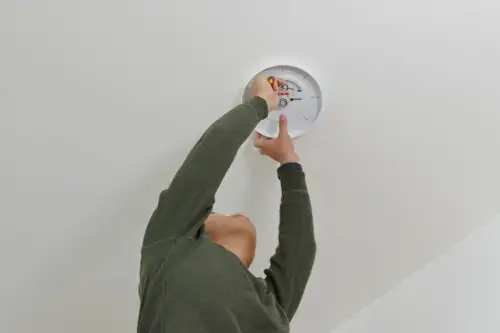
- Wiring and mounting: New wiring is routed between detector locations. Each unit is wired to the home's circuit and connected via the red interconnect wire to create the full system.
- Testing: We test every detector individually and as an interconnected system before we consider the job complete. You will see and hear every unit functioning correctly before our team leaves.
- Code documentation: If a permit is required, we handle the permit application and coordinate the inspection with the local building authority.
Most standard hardwired smoke detector installations in a typical Central Indiana home are completed within two to four hours. Larger homes or projects requiring new wiring runs through finished walls may take longer.
Related Electrical Services from Zimmerman Electric Indy
Hardwired smoke detector installation is often part of a broader home safety or renovation project. Our team serves homeowners and businesses across Central Indiana with a full range of licensed electrical services:
- Electrical panel upgrades — Learn about panel upgrade services
- Whole-house surge protection — Protect your home electronics and appliances
- EV charger installation — Level 2 home charging for all EV brands
- Commercial electrical services — For businesses across Central Indiana
- General residential electrical work — From outlets to full home rewiring
READY TO SCHEDULE A FREE PANEL ASSESSMENT?
Yes. Indiana's adopted building code requires hardwired, interconnected smoke detectors in all new residential construction and during major remodeling projects that involve electrical alterations. Existing homes that are not undergoing permitted renovation are not automatically required to retrofit, but upgrading to hardwired interconnected detectors is strongly recommended for safety and for compliance during real estate transactions.
Interconnected smoke detectors provide whole-home alerting. When one detector senses smoke, the interconnect signal wire triggers every other detector in the system simultaneously. This is critical in larger homes and multi-story residences where a single alarm from one area may not be heard in another. Indiana building code mandates interconnection in new construction specifically because single-point alarms have been shown to be insufficient for whole-home warning coverage.
In the Central Indiana market, expect to pay between $85 and $150 per unit for a direct replacement where wiring is already in place, and between $150 and $300 per unit for new installations that require running new wiring. Full home interconnected systems typically range from $600 to $2,000 or more depending on the number of detectors and the complexity of the installation. Contact Zimmerman Electric Indy at 317-939-9197 for a free estimate specific to your home.
In most Indiana jurisdictions, no. Because hardwired smoke detectors connect directly into your home's branch circuit wiring, the work constitutes electrical work that requires a licensed electrician. DIY installation without the proper license violates Indiana electrical codes, may void your homeowner's insurance, and can result in serious safety hazards if wiring is improperly connected.
Yes. Modern hardwired smoke detectors include a battery backup specifically designed to keep the unit operational during a power interruption. If your home loses power, the battery backup activates automatically and maintains the alarm's functionality until power is restored. This is one of the key advantages of hardwired units over battery-only detectors.
It depends on the buyer's lender requirements and the age and condition of the existing detectors. FHA and VA loans in particular often require functioning smoke detectors that meet current code before financing is approved. In practice, a home inspector flagging non-interconnected or battery-only detectors in a Central Indiana transaction can create negotiation delays or required repairs. Having your smoke detector system brought to code before listing is a straightforward investment that can prevent far more costly delays at closing.
Smoke detectors sense particles produced by combustion, which is the physical act of burning. Carbon monoxide detectors sense carbon monoxide gas, which is colorless and odorless and is produced by incomplete combustion from sources like furnaces, water heaters, attached garage vehicles, and gas stoves. Many modern units are combination detectors, meaning they detect both smoke and carbon monoxide in a single device. During a hardwired installation, we can install combination detectors to provide comprehensive protection against both threats with a single code-compliant system.
Zach Zimmerman
Zach is a dedicated electrical professional who leads Zimmerman Electric Indy with a focus on honest, expert craftsmanship. He specializes in ensuring every project—from 200-amp panel upgrades to complex commercial buildouts—is 100% code-compliant and safe for Central Indiana families.