
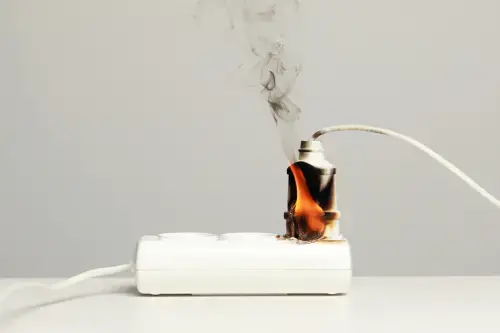
If you just walked into a room and noticed a burning smell coming from one of your outlets, your instincts are right to be concerned. This is not a situation to brush off, hope goes away on its own, or add to your weekend to-do list. A burning smell from an electrical outlet is one of the clearest early warning signs of an electrical fire in progress, and in many cases, the problem is already occurring inside your wall or at the outlet itself before you ever see visible smoke or flames.
We see this scenario regularly in homes across Indianapolis and Central Indiana, and the most important thing we can tell you is this: do not ignore it, and do not wait. The difference between acting quickly and waiting a few hours can be the difference between a manageable electrical repair and a house fire.
This guide covers exactly what a burning smell from an outlet means, the most common causes, the step-by-step actions you need to take right now, and how to prevent it from happening again. If at any point you are unsure whether your situation is an emergency, treat it as one until a licensed electrician tells you otherwise.
Is a Burning Smell from an Electrical Outlet Dangerous?
Yes. A burning smell from an electrical outlet is always dangerous until proven otherwise by a licensed electrician. Here is the key reason: electrical fires often begin inside walls, inside the outlet housing, or at wiring connections, and they frequently smolder for minutes, hours, or even longer before visible smoke or flames appear. By the time a fire becomes visible, it may already have spread through wall cavities where it is much harder to extinguish.
According to the National Fire Protection Association (NFPA), electrical fires account for roughly 46,700 residential house fires each year in the United States, resulting in hundreds of deaths and over a billion dollars in property damage annually. Many of those fires originate at outlets, wiring connections, and overloaded circuits, which are exactly the sources that produce the burning smell you may be detecting.
In Indianapolis and throughout Central Indiana, older housing stock significantly increases the risk. Homes built before 1980 may have aluminum branch circuit wiring, outdated panels rated at 60 or 100 amps, and original wiring that has degraded over decades. These conditions make a burning smell from an outlet far more likely to represent a serious hazard rather than a minor inconvenience.
|
When Is a Burning Smell from an Outlet a 911 Emergency? Treat this as a 911 emergency and evacuate immediately if you notice:
Do not attempt to gather belongings. Leave the home and call 911. Zimmerman Electric will handle the assessment after the fire department clears the structure. |
What Does the Type of Burning Smell Actually Tell You?
Not all burning smells from outlets are identical, and understanding what you are actually smelling can help you communicate more clearly with an electrician and gauge the urgency of your situation. Here is a breakdown of the most common electrical burning odors and what they typically indicate.
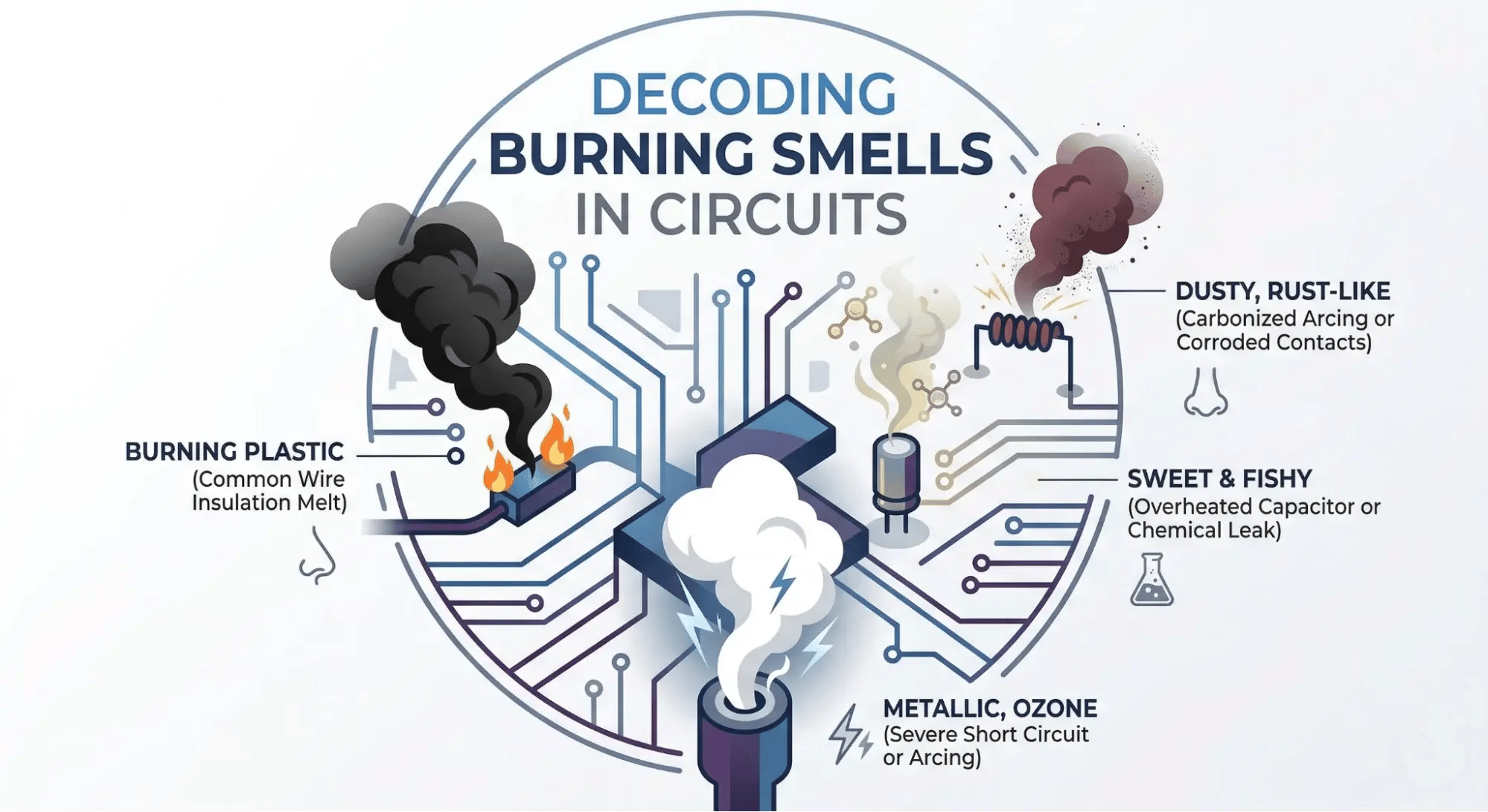
|
Smell Type |
Most Likely Cause |
Urgency Level |
|---|---|---|
|
Burning plastic |
Melting outlet housing, insulation, or wiring jacket |
EMERGENCY -- call immediately |
|
Fishy or metallic smell |
Overheating wires, connectors, or circuit breaker components |
EMERGENCY -- call immediately |
|
Burning wood or charred smell |
Structural material (wood framing or drywall) beginning to smolder |
911 + evacuate now |
|
Chemical or acrid smell |
Arc fault inside the outlet, burning flux from wiring connections |
EMERGENCY -- call immediately |
|
Brief smell then it disappears |
Possible first-use smell from a new outlet or dust on a fixture |
Low -- but monitor closely |
|
Smell only when device is plugged in |
Faulty device, but can also indicate overloaded or damaged circuit |
Moderate -- unplug device, investigate |
The single most reliable rule we give homeowners is this: when in doubt, treat any burning smell from an outlet as an emergency. It costs far less to have an electrician confirm there is no danger than to discover too late that there was.
5 Most Common Causes of a Burning Smell from an Electrical Outlet
Understanding what is actually causing the smell helps you explain the situation clearly when you call us, and it helps you understand why this problem can be more serious than it appears on the surface. Here are the five most common causes we diagnose in Indianapolis and Central Indiana homes.
1. Overloaded Circuit
An overloaded circuit occurs when the combined draw of all devices on a single circuit exceeds what that circuit was designed to handle. When a circuit runs above its rated amperage for an extended period, the wiring heats up, the insulation on the wires begins to break down, and in serious cases the insulation melts or ignites.
You are most likely to notice a burning plastic smell when a circuit is overloaded, because the plastic insulation surrounding the wires is literally softening or melting. Common culprits include space heaters, air conditioners, microwaves, and other high-draw appliances plugged into circuits that were not designed to support them, especially in older homes where circuit capacity was planned for the electrical demands of a different era.
This is one of the reasons we often recommend an electrical panel upgrade for homes with 100-amp service. A panel that was sized for a 1970s household simply cannot safely support a modern home's load without the risk of chronic overloading and the fire hazard that comes with it.
2. Loose or Damaged Wiring Connection
Loose wire connections are one of the most dangerous electrical conditions in a home, and they are also one of the most common causes of outlet burning smells. When a wire is not making solid contact with a terminal, the electricity arcs across the gap, generating intense heat at that connection point.
This arcing produces a burning smell and often creates tiny pits in the metal terminal over time. The condition tends to worsen progressively: the more the connection arcs, the more degraded it becomes, and the more heat it generates. A loose connection that produces a faint smell today can become an active fire within days if left unaddressed.
Loose connections are particularly common in homes where outlets have been used heavily for many years, in homes that have experienced any flooding or moisture intrusion, and in homes where previous electrical work was done by an unlicensed contractor who did not secure connections properly.
3. Faulty or Failing Outlet Receptacle
The outlet receptacle itself can fail over time. Internal components wear out, the spring tension in the sockets degrades, and the physical contacts inside the outlet become loose or corroded. When this happens, the contact between the plug and the outlet is poor, which creates resistance, and resistance generates heat.
A worn outlet often makes itself known through several symptoms before the burning smell appears: outlets that no longer hold a plug firmly, outlets that feel slightly warm even without a device plugged in, and outlets that occasionally cause devices to flicker or reset. If you are experiencing any of these symptoms alongside a burning smell, the outlet itself is likely part of the problem.
4. Arc Fault (Dangerous Electrical Arcing)
An arc fault is one of the most serious and least understood electrical hazards in a home. It occurs when electricity jumps across a gap between conductors, creating an extremely hot plasma arc that can ignite surrounding materials almost instantly. Arc faults can occur inside outlet housing, at wire connections, inside walls where damaged wiring exists, and even at circuit breakers in an aging panel.
Arc faults produce a distinctive smell that is often described as acrid, metallic, or chemical. You may also hear a faint crackling or buzzing sound coming from the outlet or the wall. Modern AFCI (Arc Fault Circuit Interrupter) breakers are specifically designed to detect and interrupt arc faults before they cause fires, and they are now required by the National Electrical Code in most areas of a home. Many older Indianapolis homes still rely on standard breakers that do not provide arc fault protection.
5. Aluminum Wiring or Outdated Wiring Systems
Indianapolis and the surrounding counties experienced a significant housing boom between 1965 and 1973, which corresponds exactly with the period when aluminum branch circuit wiring was widely used in residential construction. Aluminum wiring expands and contracts at a different rate than the copper terminals and connections it is attached to. Over decades, this differential movement causes connections to loosen, creating the resistance and heat buildup that produces burning smells at outlets.
Homes with original knob-and-tube wiring, which predates World War II in many Marion County and Hamilton County neighborhoods, face similar risks. Knob-and-tube wiring lacks a ground conductor and uses an open-air design that made sense in its era but becomes dangerous when enclosed in insulation or when subjected to the electrical loads of a modern household.
If your home was built before 1980 and you are noticing burning smells from outlets, our residential electrical team will inspect your wiring and give you a clear, honest assessment of what you are dealing with and what your options are.
Immediate Steps to Take When You Smell Burning from an Electrical Outlet
Follow these steps in order. Do not skip ahead, and do not dismiss any step as unnecessary.
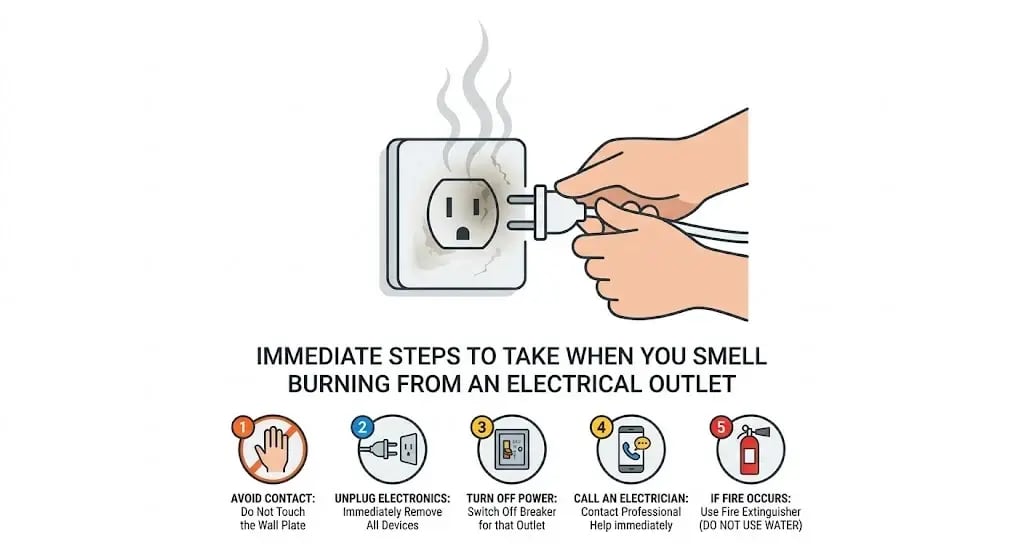
|
Step-by-Step Emergency Guide: Burning Smell from Outlet
|
What You Should Never Do When an Outlet Smells Like Burning
We want to be direct about this because we have seen the consequences of these mistakes. These are not hypothetical warnings. They are based on real calls we receive from Indianapolis homeowners after a situation has escalated beyond what it needed to be.
.webp?width=1024&height=559&name=image1%20(1).webp)
Do Not Ignore It and Hope It Goes Away
A burning smell that appears once and then fades does not mean the problem resolved itself. It may mean that a connection briefly overheated, cooled slightly, and will begin overheating again the next time current flows through it. Electrical problems of this nature are progressive. They do not self-correct.
Do Not Continue Using the Outlet
Continuing to use an outlet that smells like burning is adding fuel to a fire that has not fully ignited yet. Every additional amp of current drawn through a damaged connection, loose wire, or overloaded circuit increases the likelihood of the condition escalating to an active fire.
Do Not Attempt to Open the Outlet or Inspect the Wiring Yourself
Outlets are connected to circuits that carry 120 volts of alternating current. Even with a device unplugged, the outlet terminals remain energized. Opening an outlet cover and touching wiring, terminals, or components without proper training and equipment creates a serious risk of electric shock and can also disturb wiring connections in ways that worsen the underlying problem.
Under Indiana state law, most electrical work, including diagnosing and repairing outlet wiring, is required to be performed by a licensed electrician. This is not just a legal technicality. It is a safety standard that exists because electrical work done incorrectly by untrained individuals is a leading cause of residential electrical fires.
Do Not Use Water or a Standard Fire Extinguisher on an Electrical Fire
If an electrical fire ignites, water and standard foam extinguishers conduct electricity and can cause electrocution. If you have a Class C (electrical) fire extinguisher available and are trained to use it, and if the fire is small and contained, that is the appropriate tool. In any other situation, evacuate and call 911.
Do Not Wait Until Business Hours if the Situation Is Urgent
Emergency electrical situations do not follow a 9-to-5 schedule, and neither do we. If you are smelling burning from an outlet in the evening, on a weekend, or on a holiday, call us. We provide emergency electrical service across Indianapolis and Central Indiana.
Indianapolis and Central Indiana Homes at Higher Risk
Not every home faces the same level of electrical risk. Based on the calls we receive and the homes we inspect across Marion County, Hamilton County, Hendricks County, and the surrounding region, certain homes carry a significantly elevated risk of outlet-related electrical problems.
|
Risk Factor |
Why It Increases Outlet Burning Risk |
|---|---|
|
Home built before 1980 |
Likely original wiring not designed for modern electrical loads; possible aluminum wiring (1965-1973 builds) |
|
100-amp or 60-amp panel |
Insufficient capacity for modern household demand; circuits chronically operate at or near capacity |
|
Original fuse box |
Outdated overcurrent protection; fuses may be incorrectly sized, allowing dangerous overcurrent |
|
Federal Pacific or Zinsco panel |
Documented defective breakers that may fail to trip during overloads, allowing dangerous heat buildup |
|
Knob-and-tube wiring |
No ground conductor; enclosed in insulation (a fire hazard); extremely high resistance in aged connections |
|
Aluminum branch circuit wiring |
Connection expansion/contraction loosens terminals over time; requires specialized remediation techniques |
|
Heavy outlet usage in one area |
Multiple high-draw devices on a single circuit; extension cords and power strips compounding load |
|
No whole-house surge protection |
Voltage spikes from utility switching and lightning cause rapid, repeated stress on wiring insulation |
If your home falls into any of these categories, a burning smell from an outlet is even more likely to represent a serious underlying condition rather than a minor, isolated issue. Our team is experienced with the specific electrical challenges present in Indianapolis neighborhoods like Broad Ripple, Meridian Hills, Fountain Square, Irvington, and Southport, as well as older housing stock throughout Carmel, Noblesville, Fishers, Greenwood, and the surrounding counties.
When to Call an Emergency Electrician -- Not Tomorrow
We want to be specific about what qualifies as a situation that requires an emergency electrician call, versus a situation where you can safely wait until morning. Erring on the side of caution is always the right choice with electrical issues, but here is our clinical guidance based on what we actually encounter in the field.
Call Us Right Now (Emergency Service) If:
- You smell burning AND see scorch marks, melted plastic, or discoloration on any outlet, switch, or cover plate.
- You smell burning AND hear crackling, buzzing, or popping from the outlet or the wall near it.
- You smell burning AND the wall surface near the outlet is warm or hot to the touch.
- You smell burning AND your breaker has tripped on that circuit -- especially if it trips again after you reset it.
- You smell burning AND it is spreading to other rooms or areas of the home.
- You smell burning AND you know your home has aluminum wiring, a Federal Pacific panel, or a Zinsco panel.
- You smell burning AND anyone in your home smells the odor but cannot identify the source.
Situations That Can Wait Until Morning (But Must Not Be Ignored):
- Faint burning smell that appeared briefly and completely disappeared, with no other symptoms. Monitor closely and call us first thing in the morning.
- New outlet recently installed by a licensed electrician producing a faint smell on first use. Still call us to confirm -- this is uncommon and should be checked.
- Burning smell from a specific device that stops when the device is unplugged. The device may be faulty -- but have the outlet and circuit inspected before using it again.
When in doubt, call. There is no situation where calling an electrician unnecessarily is a worse outcome than failing to call when you should have.
What Zimmerman Electric Does When You Call About a Burning Smell
When you call us at 317-768-0298 to report a burning smell from an outlet, here is exactly what happens, so you know what to expect.
- We ask you targeted diagnostic questions over the phone. What does the smell resemble? Is there discoloration? Any sounds? How old is your home? This helps us determine the urgency level and come prepared with the right equipment.
- We arrive with thermal imaging and diagnostic equipment. Modern electrical diagnostics include thermal imaging cameras that can detect hot spots inside walls without any demolition. An overheating connection or burning wire shows up clearly on thermal imaging even before any visible damage is present.
- We conduct a full outlet and circuit inspection. This includes checking the outlet receptacle, the wiring at the connection points, the circuit breaker feeding that circuit, and the surrounding wiring within the accessible area. We do not just look at the symptom -- we diagnose the underlying cause.
- We give you a clear diagnosis and written estimate before any work begins. You will know exactly what we found, what it means, and what it will cost to fix. We do not start repair work without your approval.
- We repair the identified issue to current National Electrical Code (NEC) standards. All work is performed to code, and we pull permits and schedule inspections for any work that requires them. This protects your investment and your insurance coverage.
- We test and verify the repair before restoring power. Before we leave, we confirm that the repaired circuit is operating safely. We do not restore power and hope for the best.
We are a family-owned electrical contractor serving Indianapolis and Central Indiana since our founding. We understand the specific electrical conditions common in this region's older and newer homes, and we bring that knowledge to every service call. When you call Zimmerman Electric, you are speaking directly with people who know Indianapolis electrical work from the ground up. You can also learn more about what all of our residential electrical services include before your appointment.
How a Burning Outlet Often Connects to a Bigger Electrical Problem
A burning smell from one outlet is often the visible symptom of a systemic electrical issue that affects the entire home. We want to explain this clearly so you understand why addressing the outlet alone may not be the complete solution.
Outdated or Undersized Electrical Panels
If your home has a 60-amp or 100-amp electrical panel, every circuit in your home is operating much closer to its maximum capacity than it should be under normal modern household use. When circuits are perpetually operating near capacity, the wiring heats up more frequently, insulation degrades more quickly, and connections loosen faster. An outlet that smells like burning in a 100-amp panel home is often not just an isolated outlet problem -- it is a sign that the home's electrical system has been under chronic stress.
We offer electrical pas to bring Indianapolis homes to modern 200-amp service, which dramatically reduces the frequency of overloaded circuits and provides the capacity headroom needed to add EV chargers, modern appliances, and home office equipment without risking the condition that causes outlet burning smells.
Lack of Whole-House Surge Protection
Voltage surges from the utility grid, from lightning strikes, and from high-draw appliances cycling on and off inside your own home send repeated stress waves through your wiring and connected devices. Over time, these surges degrade insulation on wiring and damage the internal components of outlets and circuit breakers. Homes without whole-house su experience this degradation at a faster rate, which contributes to the kind of deteriorated connections and damaged insulation that cause outlet burning smells.
A whole-house surge protector is a single device installed at your electrical panel that intercepts voltage spikes before they reach your outlets, appliances, and electronics. It is one of the most cost-effective protective investments an Indianapolis homeowner can make, and it works silently every day to extend the life of your home's wiring and devices.
Commercial Properties Face the Same Risks
Burning smells from outlets are not exclusively a residential issue. Commercial buildings across Indianapolis face identical risks, particularly older downtown properties, strip retail buildings, and warehouses with original electrical infrastructure. A burning smell from an outlet in a commercial setting must be treated with the same urgency as in a residential setting. Our commercial electrical services team handles commercial outlet and wiring inspections, circuit diagnostics, and emergency service calls for businesses throughout Central Indiana.
How to Prevent Burning Smells from Outlets in the Future
Prevention is far less expensive and disruptive than emergency repairs. Here are the most effective steps Indianapolis homeowners can take to reduce the risk of outlet burning smells and the conditions that cause them.
- Schedule a whole-home electrical inspection. If your home is over 25 years old and has never had a professional electrical inspection, schedule one. An inspection identifies loose connections, degraded wiring, overloaded circuits, and panel issues before they become emergencies. This is the single most effective preventive action most older Indianapolis homes can take.
- Upgrade your electrical panel if it is 100 amps or older. A 200-amp panel upgrade eliminates the chronic overloading condition that is one of the primary causes of outlet burning smells.
- Install whole-house surge protection. A whole-house surge prot at your panel protects all wiring and outlets from voltage spikes that accelerate insulation degradation.
- Replace outlets older than 15-20 years proactively. Outlet receptacles wear out. The spring contacts inside lose tension, creating loose plug connections and resistance-induced heat. In high-use locations like kitchens, living rooms, and home offices, consider replacing outlets on a proactive maintenance schedule.
- Do not use extension cords and power strips as permanent wiring solutions. They are designed for temporary, low-draw applications. Using them as permanent heavy-load connections concentrates electrical demand at a single outlet in a way that it was not designed to handle.
- Upgrade to AFCI-protected circuits in bedrooms, living areas, and hallways. AFCI (Arc Fault Circuit Interrupter) breakers are specifically designed to detect the kind of arcing inside walls and at connections that standard breakers cannot detect. They are now required by NEC in most areas of new construction and are highly recommended as a retrofit for older homes.
- Address aluminum wiring proactively if your home has it. Aluminum wiring remediation through CO/ALR-rated devices, COPALUM crimping, or full replacement is the long-term solution for the connection degradation that causes outlet burning smells in 1965-1973 era homes.
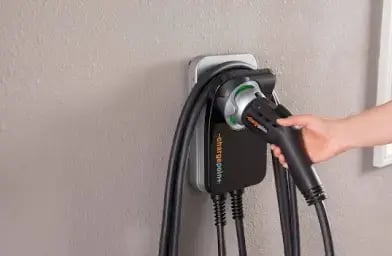
- Install a Level 2 EV charger on its own dedicated circuit. If you have or plan to get an electric vehicle, do not plug your EV into a standard outlet. The sustained draw of EV charging on a circuit not designed for it is a reliable recipe for the overloaded circuit burning smell scenario. Our EV charger installation team will size and install a dedicated circuit that handles EV charging safely.
The Bottom Line: A Burning Outlet Is Not a Minor Problem
We want to close this guide with the same directness we opened it with: a burning smell from an electrical outlet is a warning your home is giving you before something much more serious happens. It is the kind of warning that gives you time to act, time that an active electrical fire will not give you.
If you are reading this because you are currently experiencing this situation, step away from the outlet, switch off that circuit breaker, and call us. If you are reading this as preparation or because you experienced this symptom recently and it passed, call us to schedule an inspection. We serve Indianapolis and all eight counties of Central Indiana: Marion, Hamilton, Hendricks, Boone, Johnson, Morgan, Shelby, and Hancock.
We are a family-owned, BBB-accredited electrical contractor with a 4.8-star rating on Google. Every job we do is backed by a licensed team that understands Indianapolis homes, Indiana electrical code, and what it means to give a customer a straight answer. We provide free estimates, and there is no obligation to proceed.