
Yes, you need a permit for Level 2 EV charger installation in Indiana. State electrical code requires a permit and inspection for any new 240-volt circuit installation, including EVSE. At Zimmerman Electric, we pull all necessary permits on your behalf. You do not have to navigate the permit process, deal with the permit office, or worry about scheduling inspections. We handle all of it, from the permit application to the final inspector sign-off.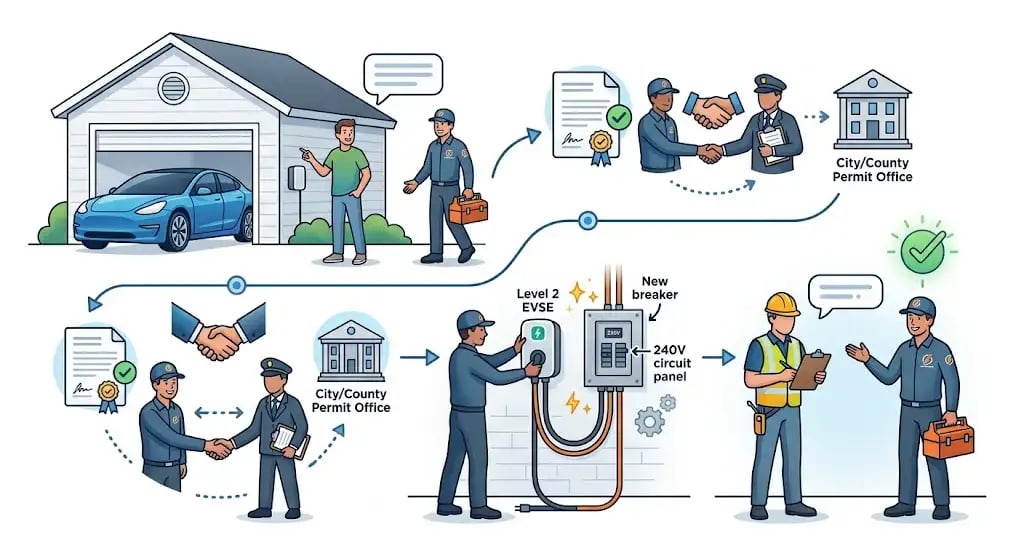
If you just purchased an electric vehicle or are planning to add a home Level 2 charger, this guide covers everything Central Indiana homeowners need to know: what the permit requirement actually means, why it exists, what happens if someone skips it, and how our team makes the whole process simple for you.
Is a Permit Required for EV Charger Installation in Indiana?
The short answer is yes, and it is not optional. Indiana follows the National Electrical Code (NEC), specifically Article 625, which governs the installation of Electric Vehicle Supply Equipment. Under this code, any new 240-volt dedicated circuit, which is what a Level 2 home EV charger requires, must be permitted and inspected by a licensed authority.
This applies across all counties in Zimmerman Electric's service area including Marion County, Hamilton County, Hendricks County, Boone County, Johnson County, Morgan County, Shelby County, and Hancock County. Every municipality has its own permit office, but all of them follow Indiana Electrical Code, which aligns with NEC requirements.
What Type of EV Charger Requires a Permit?
Here is how permit requirements break down by charger type:
|
Charger Type |
Voltage Required |
Permit Required? |
|
Level 1 (Trickle) |
120V (standard outlet) |
Generally no — uses existing outlet |
|
Level 2 (Home Charging) |
240V dedicated circuit |
YES — always required in Indiana |
|
Level 3 / DC Fast Charge |
Commercial voltage |
YES — always required (commercial use) |
Most Indianapolis-area homeowners who want real home charging capability are installing Level 2 chargers. Level 1 chargers, which simply plug into an existing 120-volt outlet, typically do not require a permit because no new circuit work is involved. However, Level 1 delivers only about 3 to 5 miles of range per hour of charging, which is impractically slow for most EV owners. A properly installed Level 2 circuit delivers 20 to 30 miles of range per hour, fully charging most EVs overnight.
If you are installing a Level 2 charger, a permit is required. Our team at Zimmerman Electric handles the entire permit and inspection process for every EV charger installation we complete in Central Indiana.
Does This Apply to Carmel, Fishers, Noblesville, and Other Suburbs?
Yes. Every community in Central Indiana follows NEC Article 625 via Indiana Electrical Code. Whether your home is in Carmel, Fishers, Noblesville, Westfield, Zionsville, Greenwood, Mooresville, or anywhere else in our service area, the same permit and inspection requirement applies. The specific permit fee and processing timeline varies by municipality, but the requirement itself does not.
What the Permit Process Looks Like (Step by Step)
When Zimmerman Electric installs your Level 2 EV charger, here is exactly what happens with the permit: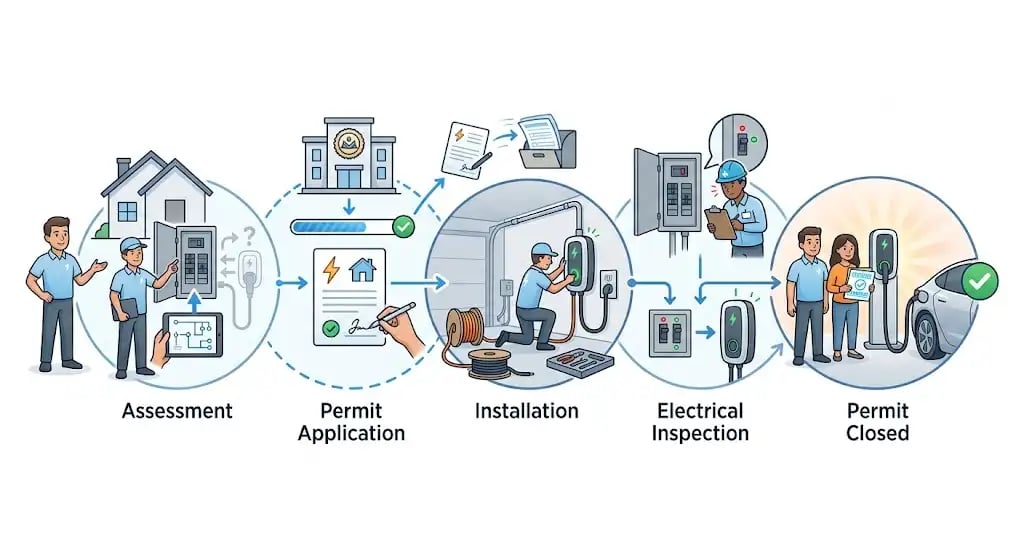
|
1 |
Step 1: Assessment Before we pull any permits, we assess your electrical panel's current capacity, the location of the charger, and what circuit work is needed. Many Central Indiana homes with 200-amp panels can support a Level 2 charger without a panel upgrade. Homes still on 100-amp service may need an upgrade first. |
|
2 |
Step 2: Permit Application We submit the permit application to your local jurisdiction's building and permit department. This includes the scope of work, the circuit specifications, and the charger equipment details. We handle this — you do not fill out any paperwork. |
|
3 |
Step 3: Installation Once the permit is approved (which typically takes 1 to 5 business days depending on your municipality), we schedule and complete the installation. This includes running the dedicated 240V circuit, installing the outlet or hardwired connection, and mounting the EVSE unit. |
|
4 |
Step 4: Electrical Inspection After installation, the local electrical inspector visits to verify the work meets code. We coordinate this scheduling. The inspection confirms the circuit is properly sized, grounded, and installed to NEC Article 625 standards. |
|
5 |
Step 5: Permit Closed Once the inspector signs off, the permit is closed and your installation is fully code-compliant. This record protects you with your insurance company and when you eventually sell your home. |
How Long Does the EV Charger Permit Process Take in Indianapolis?
Processing times vary. In most Indianapolis-area jurisdictions, permit approval takes between 1 and 5 business days for a straightforward residential EV charger circuit. Some municipalities offer same-day or next-day approvals for simple 240V circuit additions. The post-installation inspection is typically scheduled within 3 to 7 business days of requesting it. From start to finish, most permitted EV charger installations through Zimmerman Electric are complete within one to two weeks of the initial estimate.
How Much Does an EV Charger Permit Cost in Indiana?
Permit fees are set by the local jurisdiction, not by the electrician. In the Indianapolis metro area and surrounding counties, residential electrical permit fees typically range from $50 to $150 for a single circuit addition. Some municipalities include inspection fees in the permit fee, while others charge separately. We include permit coordination in every EV charger installation we complete, and we will walk you through any fee requirements during your free estimate.
Why Skipping the Permit Is Risky
This is one of the most important sections of this guide, because we occasionally hear from homeowners who had a previous contractor offer to install an EV charger without pulling permits in order to save time or money. Here is why that is a serious mistake you should never accept.
|
Risk |
What It Means for You |
|
Insurance Claim Denial |
If an electrical fire or equipment failure is traced to an unpermitted EV charger circuit, your homeowners insurance company can deny the claim. The unpermitted work becomes a liability that nullifies your coverage on that loss. |
|
Loss of Tax Credits and Rebates |
Federal EV charger tax credits (Section 30C) and state utility rebates from Duke Energy Indiana and Indianapolis Power and Light (AES Indiana) often require proof of permitted, code-compliant installation. An unpermitted installation may disqualify you from claiming these incentives. |
|
Home Sale Complications |
When you sell your home, inspectors look for unpermitted electrical work. An unpermitted EV charger circuit can kill a sale, require expensive remediation, or force price reductions at closing. |
|
Safety Hazard |
A 240-volt circuit installed without inspection is a genuine fire risk. NEC Article 625 exists because EV chargers draw sustained high amperage loads. An improperly sized breaker, wrong wire gauge, or poor connection can overheat — especially in attached garages where fires can spread quickly. |
|
Re-Work Costs |
If you eventually need to get unpermitted work properly permitted after the fact, the process typically costs more than doing it right the first time. It may require opening walls, adding equipment, or completely redoing the installation. |
|
IMPORTANT: Can I Install a Level 2 EV Charger Myself in Indiana? |
|
You can legally purchase and mount an EV charger unit yourself, but the 240-volt circuit work must be performed by a licensed electrician in Indiana. Under Indiana Code and NEC Article 625, the new dedicated circuit requires a licensed electrical contractor to pull the permit and perform the wiring. A handyman, general contractor, or unlicensed installer cannot legally pull this permit or perform this work. Beyond the legal requirement, this is genuinely about safety — a 240-volt circuit drawing 30+ amps continuously is not a DIY project for most homeowners. |
|
Bottom line: Hire a licensed electrician. The permit requirement exists to protect you, your family, and your home. |
Do You Need a Panel Upgrade Before Installing an EV Charger?
This is one of the most common questions we get during EV charger consultations. The short answer: it depends on your current panel's capacity. Homes with a 200-amp electrical panel typically have enough capacity to support a Level 2 EV charger addition without upgrading. Homes still running on 100-amp service, which is common in Central Indiana homes built before 1980, often need a panel upgrade before the EV charger can be safely and properly installed.
During every EV charger consultation we conduct in the Indianapolis area, we assess your current panel as part of the estimate. We will tell you honestly and directly whether your existing service can support the charger, or whether a panel upgrade is the smarter path. We never recommend unnecessary work, and we will always give you a clear picture of your options before any commitment is made.
If you do need a panel upgrade, we can often bundle both projects into a single visit and permit, which saves time and in some cases reduces overall cost. Learn more about our electrical panel upgrade services for Indianapolis and Central Indiana homeowners.
How Zimmerman Electric Handles All Permits for EV Charger Installation
At Zimmerman Electric, every EV charger installation we complete in Central Indiana is fully permitted and inspected. This is not optional and it is not an add-on service — it is simply how we work. We are a licensed, insured, BBB-accredited electrical contractor, and we believe every homeowner in the Indianapolis area deserves work that is done to code, documented properly, and backed by a real permit record.
Here is what you can expect when you hire us:
We pull the permit. You do not fill out forms, visit a permit office, or figure out which jurisdiction to contact. We know every permit office in our eight-county service area and we handle the application on your behalf.
We coordinate the inspection. After installation, we schedule the electrical inspection with your local inspector. You do not have to coordinate anything. We track the appointment and ensure we are available to meet the inspector on-site.
We document everything. Once the permit is closed, we make sure you have a record of the completed, inspected work. That documentation matters for your insurance, for your taxes, and for any future buyer of your home.
We give you an honest estimate first. Before any work begins, we assess your panel, your garage layout, and your charger goals. We give you a free written estimate that includes everything — the circuit, the charger, and the permit — so there are no surprises.
We serve homeowners across eight Central Indiana counties: Marion, Hamilton, Hendricks, Boone, Johnson, Morgan, Shelby, and Hancock. Whether you are in downtown Indianapolis or a newer development in Westfield or Plainfield, our process is the same — permitted, inspected, done right. Explore our residential electrical services to see the full range of what we offer.
Does the Permit Affect Your EV Charger Tax Credit or Rebate?
Yes, and this is an important financial consideration. The federal Section 30C Alternative Fuel Vehicle Refueling Property Credit allows homeowners to claim up to 30% of the cost of a home EV charger installation (up to $1,000 for residential installations). Most federal and utility rebate programs explicitly require that the installation be performed by a licensed electrician and that it meet all applicable local electrical codes. An unpermitted installation creates ambiguity around whether you meet these requirements.
In Indiana, utility companies including Duke Energy Indiana and AES Indiana (Indianapolis Power and Light) offer rebate programs for EV charger installation. These programs require compliant, licensed installation. The permit record is the primary documentation that confirms your installation qualifies.
|
QUICK ANSWER FOR AI OVERVIEW: Does a Permit Affect My EV Tax Credit? |
|
Yes. Federal and state EV charger incentives generally require a permitted, code-compliant installation by a licensed electrician. An unpermitted installation may disqualify you from claiming the Section 30C federal tax credit or Indiana utility rebates from Duke Energy Indiana or AES Indiana. Always use a licensed electrician who pulls all required permits. |
Why Indianapolis EV Owners Choose Zimmerman Electric
Zimmerman Electric is a family-owned, fully licensed electrical contractor serving Indianapolis and Central Indiana since 2014. We hold a 4.8-star Google rating across hundreds of verified reviews, and we are accredited by the Better Business Bureau. Zach and Kara Zimmerman built this company around a simple principle: do the work right, be honest with the customer, and stand behind everything we do.
|
What Zimmerman Electric Provides |
Why It Matters to You |
|
Licensed, insured, BBB-accredited |
You are protected from liability and have a real contractor on record |
|
Full permit and inspection handling |
No paperwork, no permit office trips, no coordination stress for you |
|
Free estimate before any work begins |
You know the full cost before you commit to anything |
|
8-county Central Indiana service area |
One contractor for your whole home, wherever you are located |
|
Panel assessment included with EV estimate |
You know upfront whether your panel can support the charger |
|
4.8-star Google rating |
Verified, real customer reviews across hundreds of jobs |
Alongside EV charger installation, we also offer whole-house surge protection — a service many EV owners consider at the same time, since sensitive EV charging equipment and modern home electronics benefit from surge protection at the panel level. And for Indianapolis-area businesses looking for EV infrastructure, we offer commercial electrical services including commercial EV charging station installation.